

How Much Strength Training Do You Need? A Beginner's Guide to Sets, Reps and Progression
Starting strength training is one thing. Knowing how much to do is another.
Once you start strength training, you might wonder about things like:
· How many times a week should I train?
How many exercises, sets and repetitions do I need?
How do I know when it’s time to make things harder?
There isn't one perfect answer to any of these questions. The amount of training you need depends on your experience, your goals, your schedule and how well you recover.
In this article, I'll explain the basics of training frequency, sets, reps, effort and progression so you can understand how to build your strength training over time without feeling like you need to do everything at once.
You don't need to do more just for the sake of doing more. You need enough of the right kind of training to give your body a reason to adapt.
How often should you strength train?
The goal isn't to train as often as possible. It's to do enough to give your muscles a reason to adapt while still allowing your body time to recover.
The sweet spot is enough training to challenge you, with enough recovery to allow you to improve. And for most beginners, two strength training sessions a week is a very practical place to start.
You don't want to do so little that you're not giving yourself enough of a challenge to improve. But doing more isn't automatically better either.
If you're constantly fatigued and can't recover between sessions, adding more training isn't going to help you progress.
As you become more experienced, you may choose to train more often depending on your goals, schedule and recovery. But there's no need to rush there.
If you're worried that strength training will take up hours of your week, my blog You Don't Need Hours to Get Stronger explains how you can make it work even with a busy schedule.
How many sets and reps should you do?
There isn't one magic number of repetitions that makes an exercise effective.
You can build strength and muscle using a range of repetitions, as long as the set is challenging enough. Research suggests that sets in the range of roughly 5–30 repetitions can be effective when they are performed close enough to failure.
But that doesn't mean you should suddenly start doing 30 repetitions of everything.
As a beginner, I'd much rather see you choose a weight that allows you to perform the movement well and finish your set feeling challenged than worry about hitting a particular number.
The same logic applies to the number of sets you do.
You may come across recommendations of 10–20 working sets per muscle group per week. That's useful as a general guideline, but it isn't a target you need to hit from day one.
How much you need depends on several factors, such as your training history, your goals, how much stress you're dealing with, your sleep, your nutrition and how well you recover.
Think about heating up a cup of coffee in the microwave. You probably wouldn't set a three-minute timer straight away. You'd start with a shorter amount of time, check it, and add more if needed.
Training can work in a similar way.
Start with a manageable amount and see how your body responds. You can always add more later.
Start low and work your way up.
Especially when you're starting out, prioritize good technique and quality movement rather than trying to squeeze in as much volume as possible. And try not to increase everything at the same time.
Once you're comfortable with the exercises and equipment, you can gradually add weight, repetitions or sets.
How much strength training is enough?
One of the easiest traps to fall into when you start strength training is thinking that more is always better.
Breaking news: it isn’t.
You need enough training to challenge your muscles and give them a reason to adapt. But you also need enough recovery to actually respond to that training.
If you're consistently getting stronger, performing your exercises with better control or gradually handling more weight or repetitions, those are good signs that your training is doing its job.
You don't need to leave every workout exhausted. You don't need to be sore for days. And you don't need to keep adding exercises just because you think you should.
Enough is the amount of training that challenges you, allows you to recover and gives you room to keep progressing.
How hard should your sets feel?
One of the most useful skills you can develop as you start strength training is learning how hard a set should feel.
You want the exercise to feel challenging. But challenging doesn't necessarily mean pushing yourself until you physically cannot complete another repetition.
A simple way of thinking about this is: how many good-quality repetitions do you think you could still do at the end of your set?
This is where you may come across the concept of RPE, or Rate of Perceived Exertion. It is simply a way of describing how hard a set feels.
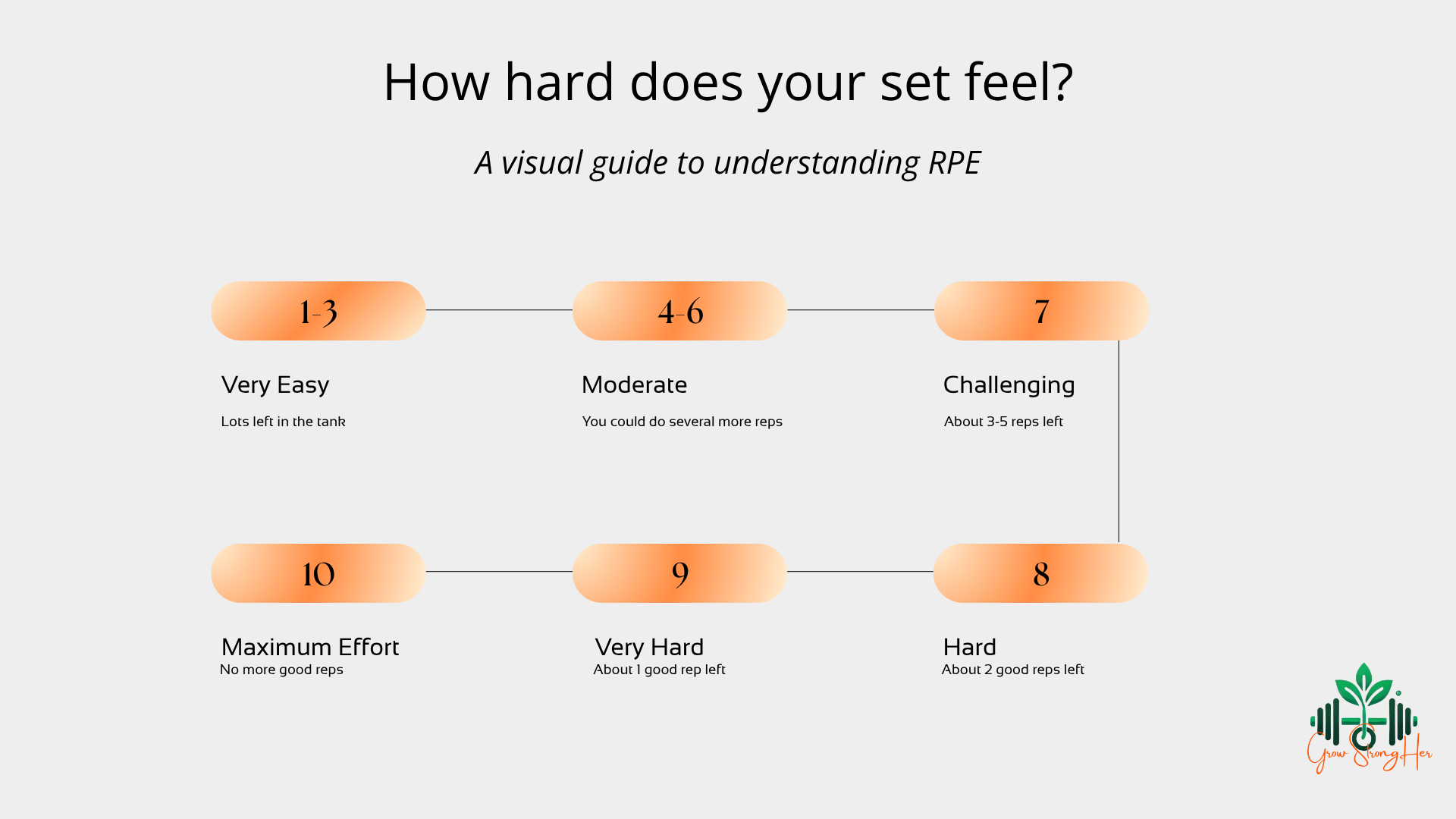
You don't need to reach failure. Aim to finish your set with a few good repetitions still left (around RPE 7–9).
If you finish a set and feel like you could easily do another five or six repetitions, the weight may not be challenging enough.
If you can't complete the final repetitions with good form, it may be too challenging.
Somewhere in between is often a useful place to train. We want the last few repetitions of a set to feel challenging, without having to push every set to complete failure.
As a set gets harder, you'll usually notice that your movement starts to slow down, and those final repetitions require more effort.
Close to failure means you're getting to the point where you could probably only complete a few more good repetitions. If you continue beyond that point, your technique may start to suffer, and the extra fatigue can make it harder to recover.
Let’s say you’re doing biceps curls with a 10 kg dumbbell for 3 sets of 10. By the ninth or tenth rep, the weight feels challenging, but you can still complete the movement with good form and perhaps have one or two good reps left. That’s close to failure.
Now imagine the weight is so challenging that you can’t complete those final reps with good form. That's beyond the level of effort we're aiming for and may mean you need more recovery before training those muscles again.
You don't necessarily need to keep going until you physically can't complete another repetition. Stopping just short of failure can give you a strong training stimulus while still allowing you to recover for your next session.
How do you know when to increase the challenge? Understanding progressive overload
Your body is very good at adapting to what you ask it to do.
That's exactly what we want from strength training, but it also means that the same workout won't keep feeling challenging forever.
If you always do the same exercises with the same weight, repetitions and level of effort, eventually your body has less reason to adapt.
This is where progressive overload comes in.
Progressive overload simply means gradually increasing the challenge of your training as your body becomes stronger.
You can increase the challenge by:
adding weight
doing more repetitions
adding a set
changing the tempo
using a more challenging variation of an exercise
You don't need to change everything at once. In fact, that's usually a good way to make things unnecessarily difficult.
Choose one variable and change it gradually.
If you change too many things at once, you’re more likely to get overworked and take longer to recover.
Let's say that at the start of your program (week 1, day 1), you are doing 10 split squats with no added weight and the set feels like an 8 or 8.5 on our RPE scale.
By week 4, you do your set of split squats and realize that those 10 reps feel more like a 7 on the RPE scale. In other words, it feels easier to do this exercise in this manner.
In this case, you could add a little weight, increase the number of repetitions or choose a more challenging variation. You only need to change one thing at a time.
The goal isn't to make every workout harder. It's to gradually increase the challenge as your body becomes stronger.
How much rest and recovery do you need?
Strength training is the stimulus. Recovery is when your body gets the opportunity to adapt to it.
That's why rest isn't something you need to earn.
If you're training two or three times a week, you'll naturally have days between your strength sessions. Those days don't necessarily have to mean sitting on the sofa, either.
You might choose to:
take a complete rest day
go for a walk
do some gentle yoga or stretching
enjoy a cardio session
do something else you enjoy that gets you moving without adding a lot of extra fatigue
The important thing is to pay attention to how you're feeling and give yourself enough time to recover.
When we think about getting stronger and developing healthy habits, it's easy to focus on food and exercise and forget about sleep and rest. But they are a big part of how your body responds to training.
If we don’t recover properly, it can be harder to see the results you're working for. And when we don't sleep well, we tend to feel more stressed and may find it harder to make choices that support our health.
What could a strength-training week look like?
Strength training doesn't have to exist in isolation.
You can strength train twice a week and still enjoy other activities, like yoga, a dance class and going for walks.
So, a training week could look something like this. Just one idea:
Day 1: Full-body strength training
Day 2: Salsa class
Day 3: Rest
Day 4: Full-body strength training
Day 5: Yoga
Day 6: 45-minute brisk walk
Day 7: Rest
You don't need the perfect program. You need enough stimulus, consistency and recovery to keep progressing.